Some conferences are so good that they deserve more than a couple of Instagram stories. In this post, I’ll present the main points and most interesting information from two events: the High Performance Basketball Symposium at the University of Central Florida in Orlando and the ESCCA Summit in Prague. The people in the audience were mainly coaches and strength and conditioning coaches. They had experience coaching at college, in the NBA and in the Euroleague. Some of them had experience coaching basketball, and some of them had experience coaching track and field.
Most sessions were recorded so you can check online for replays: here for the HPBS Orlando and here for the ESCCA. I’m grateful to Charles “Rock” Stephenson and his team for organising such a great event and making sure everything was perfect at UCF. In Prague, Kostas Chatzicritsos (Olimpia Milano Basketball) and his team of local organisers from CZ Basketball did a great job, with a fantastic setting in a basketball arena. If you like basketball and want to improve your performance, try going to some of these big events in the future.
My talk and hands-on sessions were about the “force transmission chain” in high-power movements (like acceleration, braking, cutting, and jumping). I explained how the foot, ankle, hip, pelvis, and trunk are all important parts of this chain. I also talked about how we can assess and train these parts and how this can help reduce the risk of major basketball injuries, like ACL and Achilles tendon ruptures.
One easy way to show how a bad force transmission can lead to poor movement efficiency (even when producing a good force) is with a simple one-leg vertical jump. I did this on force plates at the lab. In one case, I push down with my foot to create a vertical impulse, which is then used to lift my centre of mass and whole body into a jump. In the other case, I managed to produce about the same impulse, but this time, a bad GRF transmission results in no take-off. It looks like a magic trick, but the GRF traces show the same output (impulse, area under the GRF curve) from my lower limb muscles. However, because of how the GRF is transmitted to my system, the result is a jump (aerial time visible on the GRF trace with no force onto the ground), or no jump.

People often forget that the force that makes an athlete move in sports is not just the force that the athlete puts on the ground, but the force that the ground puts on the athlete’s body. This GRF only causes body movement if it is correctly transmitted to the centre of mass through the various joints along the “transmission chain”. This chain is mostly found in the foot (metatarsophalangeal joints), the ankle, the pelvis and the trunk. Each link in the chain should be the focus of specific training, which was the structure of my hands-on workshops.
In this post, I’ll mostly focus two things. First, how strengthening the foot can help improve this part of the « chain », and how “just” training barefoot can be a good source of invisible training. Second, I’ll explain why high-speed running is important for getting fit for basketball.
Foot-ankle training: why doing more S&C work barefoot is a smart “win-win” approach
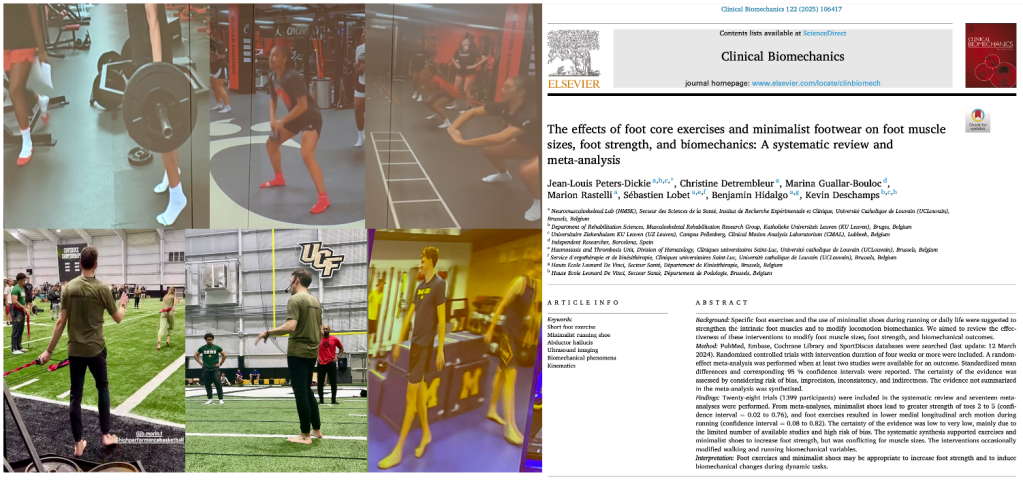
I was happy to see that top teams use barefoot/socks training at the gym. This is the same as what elite players have been posting on social media (for example, LeBron James, Victor Wembanyama, Alex Caruso and Jalen Brunson recently). They are often very good, solid and healthy players. I don’t think it’s a coincidence. For example, Matt Aldred (Michigan, 2026 National Champions) explained how important it is to be consistent when training barefoot at the gym, and showed some of the exercises he does to improve this. He also explained that players lift weights every day, or almost every day, to “distribute the load evenly across the body”.
I also noticed the same thing during the hand-son session led by Natosha Gottlieb (Cincinatti) on plyometric training. The players often do strength and plyometric training without shoes, too. It was great to see the positive changes in the players and hear what they thought about them. As you might expect, I did my hands-on session barefoot, starting with a warm-up of “foot yoga”.
The basic idea is that if you do any kind of S&C session, you should focus on other muscle groups (like your shoulders, core and glutes). But if you do these exercises barefoot (or in socks, or even barefoot shoes), it gives your feet and ankles a “free” stimulus along with the strength stimulus for the other groups. In the long term, the overall amount of this “invisible” work is huge. It is even better to train foot strength specifically (see our training study here), but you can also get a lot of benefit from walking, living and doing strength and conditioning sessions barefoot or in conditions that are like being barefoot. In this review, Belgian researchers show the effects of foot training on foot strength and muscle volume. They also add the barefoot/minimalist shoe option. They conclude that “Foot exercises and minimalist shoes may be appropriate to increase foot strength and to induce biomechanical changes during dynamic tasks”. Most of the studies looked at how walking and living with minimalist shoes (like Nike Frees or Barefoot-like shoes) can make clear changes. Once more, this will never be as good as getting stronger feet by putting more weight on them, but doing more gym sessions without shoes can make a big difference. I currently use this type of shoe or simply socks when going barefoot is not safe (dust, dirty surfaces etc), but I go barefoot whenever I can. Are you running or sprinting barefoot or in minimalist shoes? No. This is something that many athletes find very stressful. It is better to use a regular low/tolerable stress than to have occasional high stress. As Ryan Horn (Indiana) said, it is important to be consistent and to make progress: “built calluses, not blisters”. This is true for any kind of training, including barefoot training.
Why basketball players should sprint, and more importantly: How.
I know basketball is not sprinting, and players are not sprinters, but the game includes high-acceleration-power movements, during which it is important to be able to accelerate quickly over short distances. Many game movements put a lot of strain on the hamstrings and calf-ankle muscles, and sprinting can very efficiently stimulate these. A good example of this was given by Ryan Horn from Indiana, who used sprint running up to three times per week during the season. Day 1: Chase emphasis, Day3: “Evade”, and on Day5, game day: Race. When I asked how the team was doing with non-contact muscle injuries, the answer was “pretty well”, as I expected. It makes sense, as there is no better way to get ready for the demands and strain on the lower limb muscles and tendons (mainly the hamstrings and calves) than by sprinting itself.
Let’s explore the two ends of the sprint spectrum.
1. Low-speed / High propulsive force for acceleration.
I will not write again what was discussed in several previous posts, high-acceleration (cutting movements, change of direction, driving the ball) is associated to a high propulsive force production, in the direction of motion (basic laws of movement mechanics). So to stimulate and develop this force production and orientation capacity, very short sprints (up to 5 meters) are key to reproduce the mechanical conditions of low-speed / maximal acceleration. By definition, longer sprints induce higher speed, but at the same time lower acceleration, so they are not a good stimulus for the “left” part of the force-velocity spectrum.
To help players stay in this part of the spectrum and work for longer each rep (and avoid reaching the high-speed/low-acceleration zone), resisted sprinting is a very useful method. If there is no resistance, a player will pass the centre of the FV spectrum and reach the right part (the high-velocity part) in less than 2 seconds. Instead, you should push against resistance. This will make sure the propulsive work is done in the left part (high force, low velocity). This will emphasise the acceleration and power work. As our recent meta-analysis showed, the effectiveness of resisted sprint training depends on the load. So, the loads should be set to around 50% of the fastest running speed (i.e. 50% of the speed at which you start to run slower) to get the most out of the training. We talked about this in a previous post.
To do resisted sprint training, you can use traditional sleds, or motorised devices like the 1080 Sprint, which are accurate but expensive. Another option is the low-cost Exergenie pulley system. I’ve been using this system for my own training, consultancy and coaching sessions for more than five years and it is very reliable. It can deliver resistances of any level (minimal to infinite) and thus target any running speed. Check out my blog post for more information, and use the code JBM20 to get a discount at the French retailer. I’ve had great feedback from users and we had fun using it with coaches during the workshops in Orlando and Prague. One of the best things about it is that you can take a 300-kg load on the plane and still have a 2-kg small bag that you can carry on. It’s the best value for money. If you travel with it as a carry-on luggage, be ready to open it and explain what it is to security agents.
Finally, one benefit of high-resistance sprint training that often gets overlooked is that it acutely makes the foot, ankle and calf muscles very stiff. This helps to push the body forward effectively against resistance. High-resistance sprinting helps to make your foot and ankle stiffer, which is not (or at least much less) the case when when accelerating against low or no external load. I think this type of exercise alone can make your feet and calves much stronger and stiffer. This is based on consistent field observations and mechanical logic, but further scientific studies would be needed to provide more evidence. One easy way to experience the strain of high-resistance running is the muscle soreness you will feel in the calf and Achilles tendon on the days after a good session. DOMS don’t lie, so you’ll probably feel the pain in your glutes too. This is the second most important muscle group when you’re pushing against resistance.
Warning: as with any type of intense but efficient exercise, players should gradually start to sprint progressively, especially when pulling heavy loads. This should be done safely and should be accompanied by regular strengthening exercises for feet and calves. This will help players to benefit from the exercise without suffering from it. The dose makes the poison, and the vaccine principle shows that the problem and the solution have exactly the same basic content, but are dosed and administered differently.
2. High-speed for hamstrings and calf-ankle-foot plyometric stimulus
At the other end of the range of force-velocity acceleration, high-speed running (at around 90% of a player’s top speed) is a very good and practical way to stimulate the hamstrings and the foot-ankle-calf complex. Yes, I know basketball players don’t run at full speed on the court. The idea is not to train for high-speed itself, but to use high-speed to provide an irreplaceable mechanical stimulus. Basketball players never squat heavily on the court either, but squatting is a great way to make the lower body and torso stronger. We don’t question the usefulness of squatting or deadlifting for basketball players, even though they don’t do these moves on the court. Similarly, we shouldn’t question the value of high-speed running, even though players rarely reach high speeds during games.
First, high-speed running is the best way to make the posterior thigh mucles stronger. It allows both a high activity (several modeling or EMG-based studies show it) and a high and fast lengthening of the hamstrings compared to gym-based exercises. These two mechanical features are the part of the mechanical strain, and it is very difficult, if not impossible, to match the sprint levels of joint angular velocity, muscle stretching and activity and overall short timing of action with gym-based exercises or even running drills. Basketball players often hurt their hamstrings. This is often because they bend their hips and trunk (the middle part of the body) a lot, and also extend their knees. So, even if these actions happen at low speeds, the hamstrings are put under a lot of strain. This is why high-speed running is a very interesting exercise to help you get ready. It’s not because of the same running speed, but because of the same level of strain on the hamstrings. Once more, the pain from your muscles after a sprint session will be felt a couple of days later. As we talked about during the hands-on session and the sprint session after the conference in Prague, a good training plan is to run 4-6 20-metre “tempo” runs around 90% of top speed every week (if possible over two different sessions rather than a single, big one). But it’s very important to do it well. You need to warm up properly, and most importantly, you need to make sure the players are familiar with sprinting and running in the correct way. Invest in your own sprint training. You can’t coach or teach if you don’t have the right qualifications and training yourself. If you do it anyway, you may take risks with the players. Caroline Prince’s PhD thesis compared estimates of hamstring strain when doing different exercises. She found that running drills and different running speeds (from slow to maximal) caused the biggest strain/length and muscle activity.

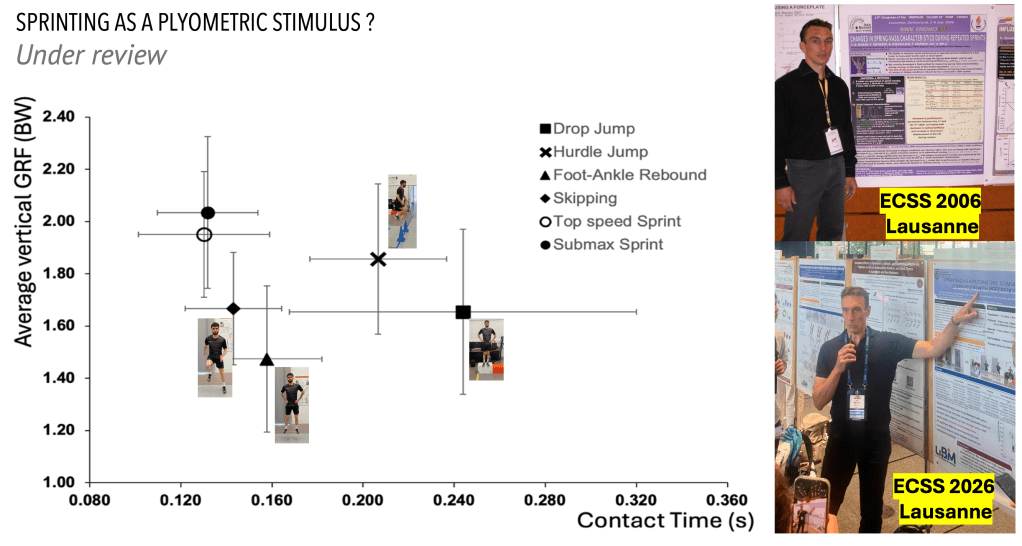
Secondly, the results of our recent study (you can find a pre-print paper here) show that high-speed running (which we define as running at top speed and 90% top speed) allows athletes to produce very high amounts of ground reaction force (on a single leg…) within very short contact time. The “plyometric” tasks that we tested did not cause similar levels of high force and short contact time in the trained participants that we tested (some of whom were high-level sprinters/hurdlers). The ‘classical’ drop jump task (DJ) led to one of the lowest ground reaction force outputs and the longest contact time (about 240 milliseconds on average, compared to 120 milliseconds on average for both sprint conditions). As shown in our main Figure below, there was also a much bigger difference in the mechanical outputs for the DJ compared to the sprint conditions. This suggests that, compared to “just sprinting”, DJ is only interesting if it is well mastered/performed, which is not the case for many athletes. I compared DJ to the “Nordic Hamstring Exercise” of plyometrics for a few reasons. First, it has been studied a lot in the last 30 years. This means that many people think of it as a “go-to exercise”. However, it is only interesting if it is performed correctly. Unfortunately, this is often not the case.
As for the Nordic, many athletes don’t have the skills or strength to really benefit from doing the Nordic curl as a fast-SSC/plyometric exercise. In this study, we suggest that there are better ways to do high-intensity, fast plyometrics. Sprinting (at top speed or 90% of top speed) is the one with significantly shorter contact time and greater average ground reaction force. It was also very interesting to see that when they ran at less than full speed, their body didn’t generate different ground reaction force traces to when they ran as fast as they could. So, in addition to the previously discussed top stimulus for the hamstrings, submaximal “tempo” sprints can bring a very high-quality plyometric stimulus. These results were a cross-sectional acute comparison, and I presented them as a poster at the European Congress of Sport Science in Lausanne. The training study is being planned…
This Drop Jump comment connected perfectly with Jason Pedley’s talk (Cardiff Metropolitan University), who presented on the “50 Shades of Drop Jump” (see his extensive work on DJ mechanics and especially force-time curves here). One of his points was that some athletes, with overall poor DJ technique and pre-activation, show “camel” force-time traces, with huge initial peak and then long force plateau before a final push-off, whereas better athletes (“sharks”) show force-time curves that look like a shark fin. A very interesting part of the talk was the connection with DJ performance but also ACL risk. Overall, just like the Nordic for hamstrings, the DJ is an interesting testing and training stimulus, if and only if it is performed correctly (which is not straightforward for any athlete and requires time and training) and if force-time data are available. In my opinion, based on this discussion and the fact that other exercises (including simple, high-speed runs) may elicit equal or even greater plyometric stimuli, the systematic interest of the DJ for all athletes is questionable.

To sum up, it was great to meet the basketball coaching and S&C community at these two conferences. I was lucky to bring my son to Orlando and my wife to Prague, so we could enjoy ourselves together. Matt Aldred said in his presentation that it’s a good idea to bring your kids to work. If you want to really understand your kids or teenagers, try also travelling alone with them.

